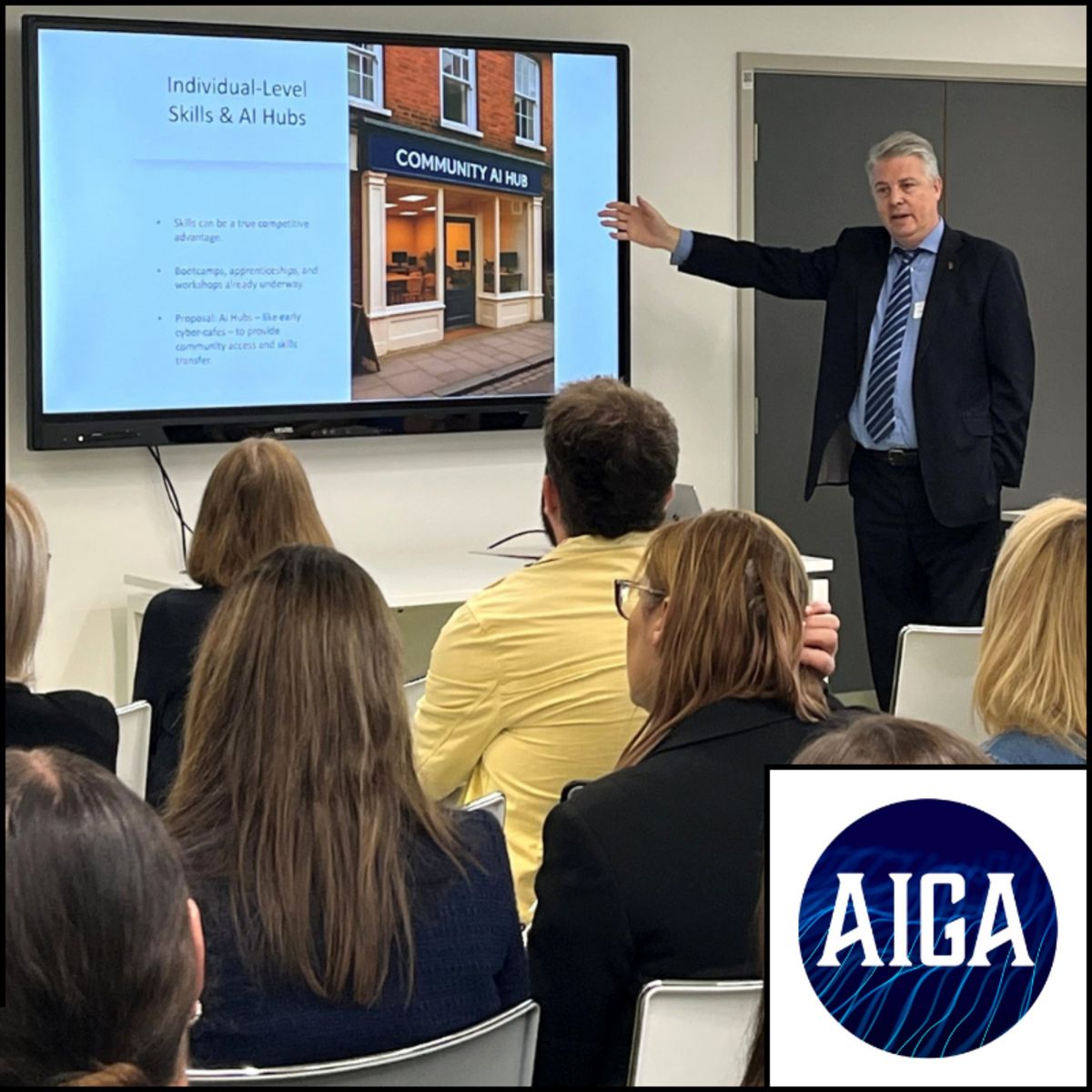
Last week, I introduced the Skills & Leadership Working Group and the important role it will play in building confidence, capability, and leadership for AI across our region.
This week, I’m focusing on the Ecosystem Coordination Working Group, and how it will help bring together the many organisations already contributing to AI growth across Hampshire, the Solent, and the wider South Central region.
Ecosystem Coordination: Connecting the Region’s AI Community
One of the most important roles of the AI Growth Alliance is helping our region work together more effectively.
Artificial intelligence will not grow through isolated projects or individual organisations acting alone. Success depends on building a strong ecosystem where universities, businesses, public services, and communities are connected and able to collaborate.
That is the purpose of the Ecosystem Coordination Working Group, led by Philip Alford, a lecturer in the Department of Digital & Data Driven Marketing at the University of Southampton.
This group will focus on how we strengthen collaboration across Hampshire, the Solent, and the wider South Central region so that knowledge, opportunities, and resources flow more easily between organisations.
At the AIGA workshop last October, a consistent message came through clearly: while the region has strong capabilities, activity is often fragmented and sometimes duplicated. The opportunity now is to bring those efforts together into something more coordinated, visible, and impactful.
A key part of this is connecting what’s often described as the “quadruple helix”, bringing together academia, industry, the public sector, and civil society into a more unified and collaborative system.
What this group will explore
The working group will begin by looking at practical questions such as:
What are the biggest barriers to coordination across our regional AI ecosystem?
How can universities, SMEs, public bodies, and investors collaborate more effectively?
What practical steps can help partners share knowledge, resources, and opportunities?
There is also an early focus on how we align activity across the region—whether that’s funding opportunities, shared priorities, or clearly defined roles for different organisations.
These questions reflect a core principle of the Alliance: no single organisation can shape the future of AI adoption alone. Collaboration is the foundation for building a successful regional ecosystem.
First meeting – 22 April
The group will hold its first meeting on 22 April at the Boldrewood Campus, University of Southampton.
This session will bring together stakeholders from across the region to begin shaping a more coordinated approach. The discussion will focus on understanding the current landscape, identifying common challenges, and starting to define what a joined-up regional AI ecosystem should look like in practice.
Why this matters
Coordination might sound abstract, but in practice it is what enables growth.
When the ecosystem works well:
SMEs can find the right partners and expertise
Researchers can connect with real-world challenges
Public sector organisations can access innovation more easily
Skills providers can align training with industry demand
Ultimately, the goal is simple: to make it easier for people and organisations across the region to work together to deliver responsible AI growth.
If we get this right, we don’t just create activity, we create a coherent, investable AI ecosystem that positions the South Central region as a credible and competitive place for AI innovation.
Looking Ahead
Over the next few newsletters I will introduce the other working groups that will help shape the work of the AI Growth Alliance:
AI Infrastructure & Investment
AI Ethics & Inclusion
Each of these groups play a different role, but together they form the foundation for a coherent regional AI strategy.
If you missed it, you can also read about the Skills and Leadership workgroup.
Get Involved
If you work in education, training, workforce development, or are a business leader interested in AI adoption, the Skills & Leadership Working Group would benefit greatly from your insight.
We are particularly interested in connecting with:
SMEs experimenting with AI
training providers developing AI-related programmes
organisations supporting workforce reskilling
leaders thinking about responsible AI deployment
If you are keen to contribute to the AI Skills and Leadership workgroup, or indeed to any of the working groups then please
Subscribe to this newsletter via https://newsletter.aigrowthalliance.co.uk/subscribe
Drop us a line via [email protected]
Sign up to the Growth Alliance via https://hub.futuretowns.soton.ac.uk/aiga
I look forward to working with all of you.
David Patterson
Chair, AI Growth Alliance
This week's Newsletter was written by David Patterson using a structure suggested by Claude and edited using Grammarly. All images created using Canva and this newsletter is produced and managed using beehiiv